
Wikipedia Evidence Standards: How to Avoid Rejection
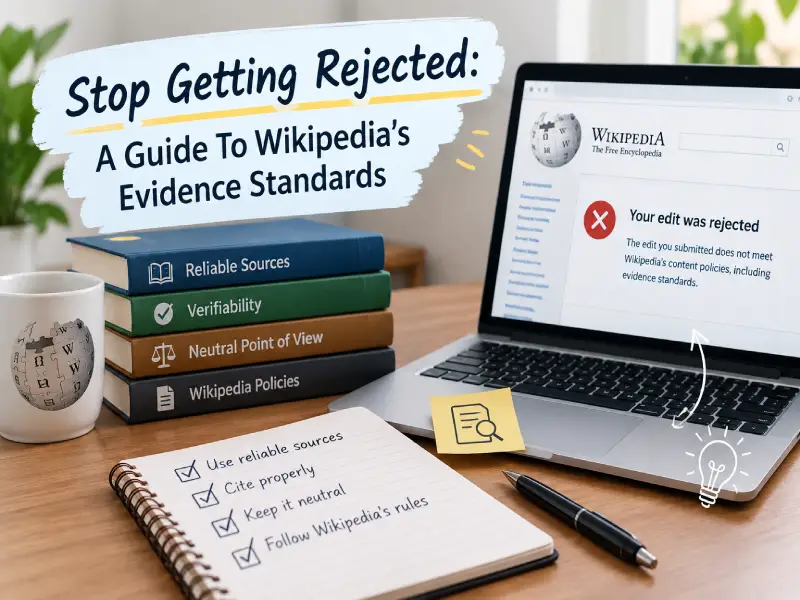
It might look deceptively simple to create a Wikipedia article. You are required to research a subject, write a few paragraphs, add references, and submit it. The surprise often comes when the draft is rejected, tagged for deletion, or disappears altogether.
The problem is not always about the bad writing. Wikipedia is operated on editorial standards that are very different from a company website, press release, or personal blog. Notability, neutral language, independent sourcing, verifiability, and conflicts of interest are all important for Wikipedia articles. Wikipedia editors made more than 94 million changes in 2025 across its language editions that shows just how active the editorial community remains. If you understand those standards before publishing, it can save considerable time and prevent avoidable mistakes.
Why Do Wikipedia Articles Get Rejected?
Rejection of your Wikipedia articles usually reflects one or more editorial concerns instead of a single spelling or formatting mistake. It is better to understand the common failure points to make the review process much easier to navigate and get noticed on Wikipedia.
● Subject Does Not Meet Notability Guidelines
Even a well-written draft can still be rejected because the available evidence does not establish sufficient independent coverage. This situation often occurs with startups, consultants, local businesses, executives, authors, musicians, and recently launched products.
If you are being visible online, it is not automatically the same as receiving significant independent coverage. Editors often recommend waiting until stronger sources exist instead of publishing a page prematurely.
● Sources Are Mostly Self-Published
This is another of the most common traps of publishing a Wikipedia article. A company may submit its official website, investor presentation, press releases, LinkedIn page, YouTube channel, and social accounts as references. Those sources can help you verify straightforward information, but they generally do not establish independent notability.
It is a useful test to temporarily remove every source that is controlled by the subject. If little substantial evidence remains, the draft probably needs stronger research before you submit the article.
● Article Sounds Like Public Relations
When a person reads a Wikipedia article, it should not be like corporate copy. You should consider the difference between “XYZ is a pioneering global leader that is delivering revolutionary solutions” and “XYZ develops software for financial institutions.” The first is making a promotional judgment, while the second is describing an identifiable activity.
This is one reason that organizations sometimes hire Wikipedia editing services without understanding that polished prose cannot compensate for weak sourcing or promotional intent.
● Writer Has A Conflict Of Interest
Wikipedia strongly discourages editors from directly changing articles about subjects with which they have a financial or personal connection. Paid contributors must also disclose relevant employment, clients, and affiliations under Wikimedia’s terms.
This does not mean that every connected person is forbidden from participating. It means that you need to handle the relationship transparently and carefully, particularly when changes can make the subject look more favorable.
What Are The Steps To Avoid Rejection Or Deletion?
A successful submission can often begin well before the author presses the publish button. The following process can help you to identify weaknesses early and give editors something solid to evaluate to qualify for Wikipedia.
1. Check The Subject Before Writing
You should not start with the article, but with the evidence. Now search for independent newspaper coverage, scholarly publications, books, substantial magazine articles, and reputable industry reporting. Must look for sources that discuss the subject in meaningful detail instead of merely mentioning it. Writing the article immediately may be premature if independent coverage is scarce.
2. Separate Independent Sources From Promotional Ones
In this step, create two research groups. You should put company-controlled material in one and independent material in another. The second group should need to contain the article. If you are using official sources, they can still be useful for uncomplicated facts, but they should not become the foundation of the entire page.
3. Draft Around Verifiable Facts
You need to write only what your sources are actually supporting. If a source is saying an executive founded a company in 2018, you can report that fact in your article. If it merely says that the executive described the company as transformative, then you should not quietly convert that statement into an objective claim. Good Wikipedia writing follows the evidence instead of stretching it.
4. Remove Marketing Language And Unsupported Claims
You should read the draft as if you were a skeptical editor who knows nothing about the subject. Now delete adjectives that cannot be defended and remove exaggerated claims. Ensure you avoid vague statements about leadership, importance, influence, or reputation unless reliable sources explicitly establish them. Neutral writing does not mean that it is dull writing, but it is disciplined writing.
5. Address Conflicts Of Interest Properly
If you are connected to the subject, you should disclose that relationship and avoid treating Wikipedia like a client-controlled publication. The safer approach is often to research, propose improvements, and use appropriate discussion channels or get help from Wikipedia support services in the USA for professional projects instead of directly controlling the wording of an article.
6. Understand What Happens During Deletion Review
Not every deletion happens immediately. Wikipedia has different deletion mechanisms, that includes speedy deletion, proposed deletion, and community discussions. Articles that do not qualify for speedy deletion can be taken to Articles for Deletion, where editors discuss whether the page should remain. This means that a deletion notice is not necessarily the end of the story. The correct response is usually to use evidence and policy-based discussion, not to repeatedly recreate the same page.
People’s Common Queries About Wikipedia Articles
Is it allowed for anyone to create a Wikipedia article?
Yes, it is allowed to collaboratively edit Wikipedia, so anyone can contribute, but they must follow its policies and guidelines. It is different to create an article from getting one accepted. The subject should meet relevant inclusion standards, and the article should have reliable sources and appropriately neutral content.
How many sources do I need to add in a Wikipedia article?
There is no fixed number of sources that you need to add in a Wikipedia article. Quality, independence, and depth of the sources matter the most. It is more useful to consider handful of substantial independent sources can be more useful than dozens of superficial references. Your chosen sources should also directly support the significant claims of the article.
Can I restore a deleted Wikipedia article?
Yes, you can sometimes restore it. The appropriate route depends on the reason for deletion and the process of deletion. Restoration may need to involve addressing the original concerns, requesting review, or rebuilding the draft with substantially better sourcing. When you simply recreate an unchanged version, it usually does not solve the underlying issue.
Final Verdict
Wikipedia articles often get rejected or deleted just because they fail editorial requirements, not because editors simply dislike the subject. Weak independent coverage, poor sourcing, promotional language, conflicts of interest, and unsupported claims are among the biggest obstacles. The practical solution is to research first, establish genuine notability, write neutrally, disclose relevant relationships, and treat Wikipedia like an independent encyclopedia instead of a marketing platform. The submission process becomes far more predictable with that mindset.

I am the creative voice of WikipediaSupport.com, where I translate the complexity of Wikipedia editing, policy, and page management into understandable, useful advice. My material simplifies neutrality requirements, sourcing requirements, notability principles, and deletion processes into simple recommendations for people and organizations. I concentrate on assisting customers in approaching Wikipedia in an ethical and strategic manner, creating trustworthy articles, avoiding typical blunders, and using the site with confidence and an understanding its guidelines.